A canvas print is a forgiving thing. No mount, usually no glass, and often no frame at all — just a stretched surface and a wall. That freedom is exactly why framing mistakes slip past unnoticed until the piece is up and something feels slightly off: a pinched edge, a reflection where you expected texture, a corner that drifts away from the wall.
None of these problems are costly to put right. Most come down to a handful of decisions made in the wrong order. Here are the ten that come up most often, and what to do instead.
Glazing a canvas that doesn't need it
A stretched canvas arrives finished. It has a coated or varnished surface, it has depth, and it is designed to be seen without a sheet of glass between you and it. Put it behind glazing and you create a sealed layer of air against the surface. When room temperatures shift, that layer can condense, and moisture sitting against a canvas is how you end up with a dull, patchy finish or, in a cold room, mould.
There is a second problem: reflections. Glass and acrylic both catch whatever light is in the room, and that competes with the texture you paid for.
Glazing does have a place. An unvarnished canvas in a kitchen, a hallway where people brush past, or a home with curious small hands may benefit from protection. If you do glaze an unvarnished canvas, fit a spacer so the surface never touches the glass, and check it now and then. Otherwise, a coat of varnish is the better answer.
Getting the spacing wrong
Spacing is where a frame quietly tells the eye whether it belongs. In a traditional frame, the rebate should overlap the canvas edge by a consistent few millimetres on all four sides. In a floater frame, the canvas sits inside a visible gap — usually a few millimetres to around half a centimetre — and that gap must be even.
It rarely is, on a first attempt. Measure all four sides with a ruler rather than judging by eye, because the eye corrects small differences and the result reads as crooked even when the frame itself is dead level. Before you start, check that the canvas is square by measuring the two diagonals; if they differ, no frame will sit well.
A frame that has to be forced into place will not stay right for long.
Choosing fixings that don't match the weight
A large framed canvas in solid timber is heavier than it looks, and the weight is the whole story when you are choosing what to hang it on. Common errors: a single nail, a hook rated for a small picture, or a length of wire strung tightly from corner to corner across the back.
Better practice:
- Use two wall fixings rather than one, so the piece cannot swing or tilt.
- Fix into a stud or a solid wall wherever you can. In plasterboard, use a proper hollow-wall anchor; in brick, drill and use a plug.
- Fit two D-rings, one on each side about a third of the way down from the top, and run the cord between them as close to horizontal as you reasonably can — a steep, tight V puts far more strain on the cord and the rings.
- Choose fixings rated comfortably above the weight of the finished piece, and keep the receipt for the hooks, not the artwork.
Ignoring the depth of the canvas
Stretcher bars come in different depths, from slim bars to deep gallery profiles. A frame that is shallower than the canvas will not take it: the canvas sits proud, the moulding floats away from the wall, and the whole thing leans. Forcing it damages the corners of the stretcher and can loosen the canvas itself.
Measure the depth from the face of the canvas to the back of the bars before you buy, and match that to the frame's rebate depth. If you love the frame but the maths doesn't work, that is a sign to look at floater frames, which are built to sit around a deep canvas rather than over it.
Framing the print instead of the room
A heavy ornate gold moulding around a clean, contemporary photograph fights it. A skinny black frame around a warm, traditional landscape can look apologetic. The frame is not there to match the sofa; it is there to support the piece and sit happily in the space.
Two practical tests. Hold a sample of the moulding against the canvas and step back — the frame should feel like a margin, not a headline. Then look at it in the room's own light, at the time of day you will actually see it. Warm bulbs and north-facing daylight change how a frame colour reads, and a frame that looked right in the shop can turn brassy or grey at home.
Forgetting the back of the frame
What happens behind the frame matters more than most people expect. Dust, insects and general household grime build on the back of a canvas, and a frame with an open back gives them a clear route in.
A simple paper dust cover taped across the back keeps most of that out while still letting the canvas breathe. What you should avoid is sealing an unframed canvas or frame back with plastic sheeting, which traps moisture and is one of the quickest ways to spoil a print. If the piece is going on a cold external wall, consider a small air gap or a batten to keep it off the surface.
Mistakes made at the last minute
Hanging is where good framing gets undone. The usual suspects are height, spacing and light.
For height, a common guide is to place the centre of the artwork at roughly eye level, somewhere around 145–150cm from the floor. In a room where people mostly sit, that will feel too high — drop it. Above a sofa or sideboard, leave a gap that relates to the furniture below rather than floating the piece near the ceiling.
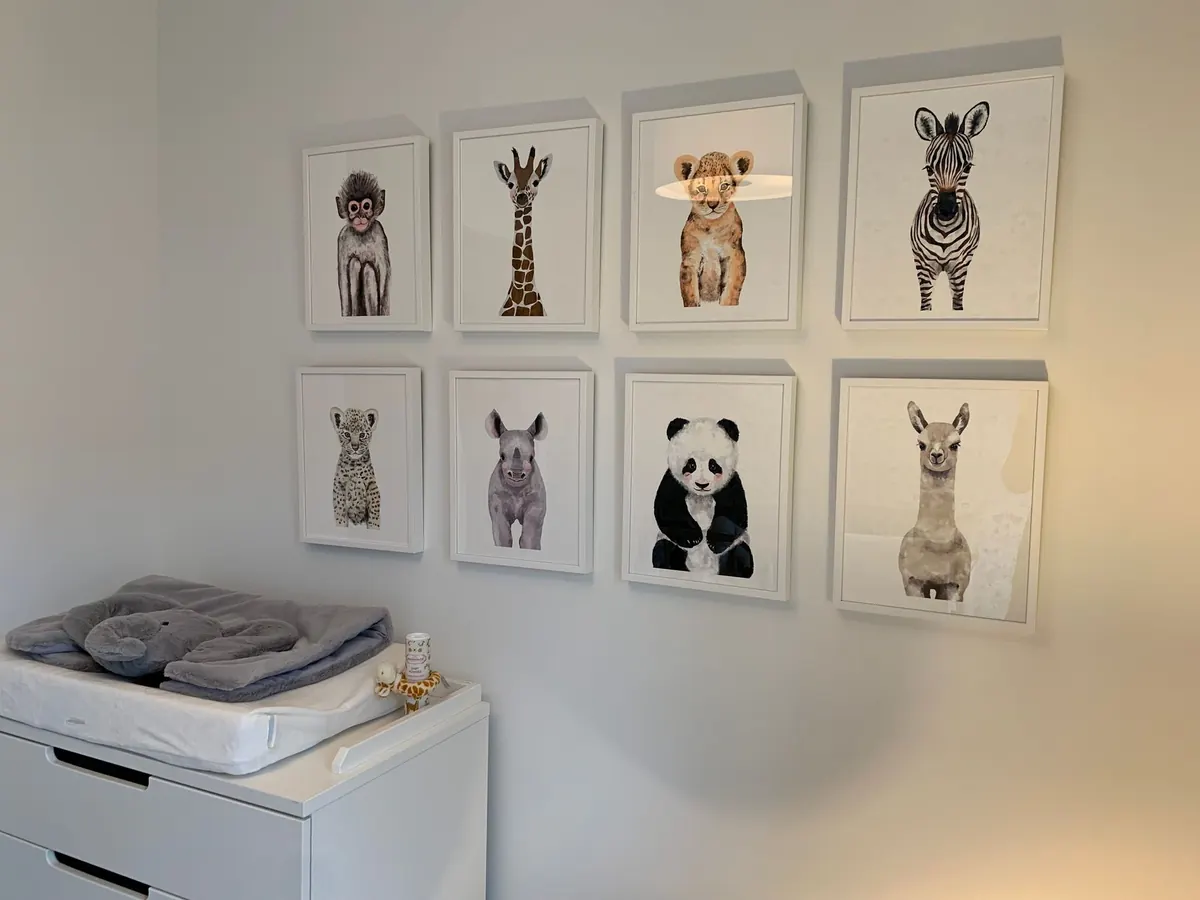
For a group of prints, pick a rule and stick to it: align the centres, or align the tops. Keep the gaps between frames equal. Then check the light. Direct sun will fade inks and can yellow a varnish over time, so a wall that takes hours of strong afternoon sun is worth avoiding.
A five-minute check before you hang it
- Is the canvas square, with tight corners?
- Does the frame's rebate clear the stretcher bars without any pressure?
- Is the gap even on all four sides, measured rather than guessed?
- Are the fixings rated for the weight, with two points of support?
- Is the centre of the piece at the height you actually want to look at?
- Have you seen the frame in the room's own light?
Get those right and the frame disappears, which is precisely what a good frame should do. The print does the talking.
Photo: Tyra Xu / Pexels